
Neon Art

About :
These are the ultimate statement pieces which combine intricate artistic ideas and vibrant glass neon elements into stunning 3D wall sculptures. Each artwork is one-of-a-kind, requiring extensive hours of artistic vision and precision craftsmanship.
Glass craftsmanship :
The traditional handcrafted glass tubes are vacuum filled with neon or argon gas which illuminate in a 360-degree radius, casting a vibrant reflection off the high-gloss brushed aluminium surface of the artworks.
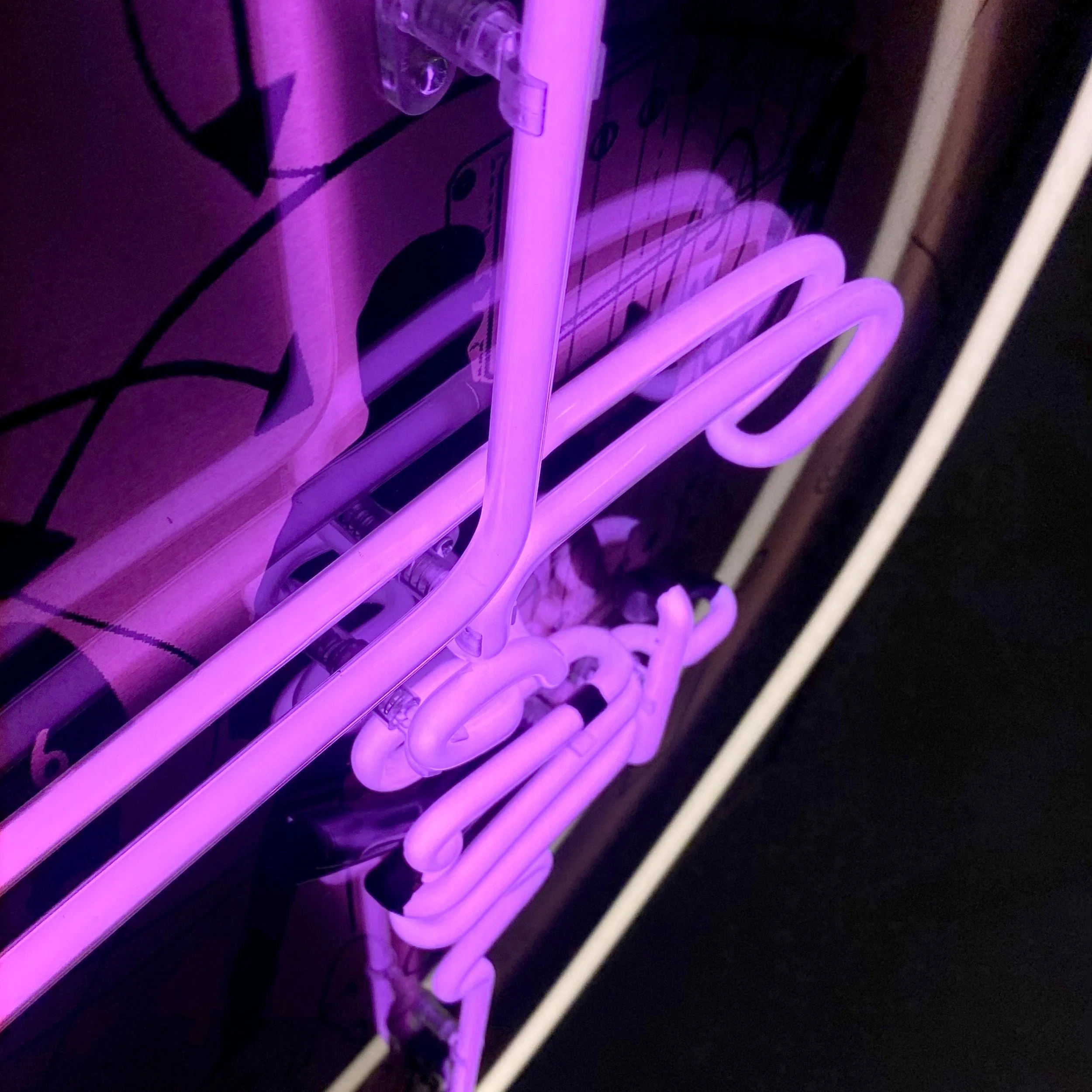
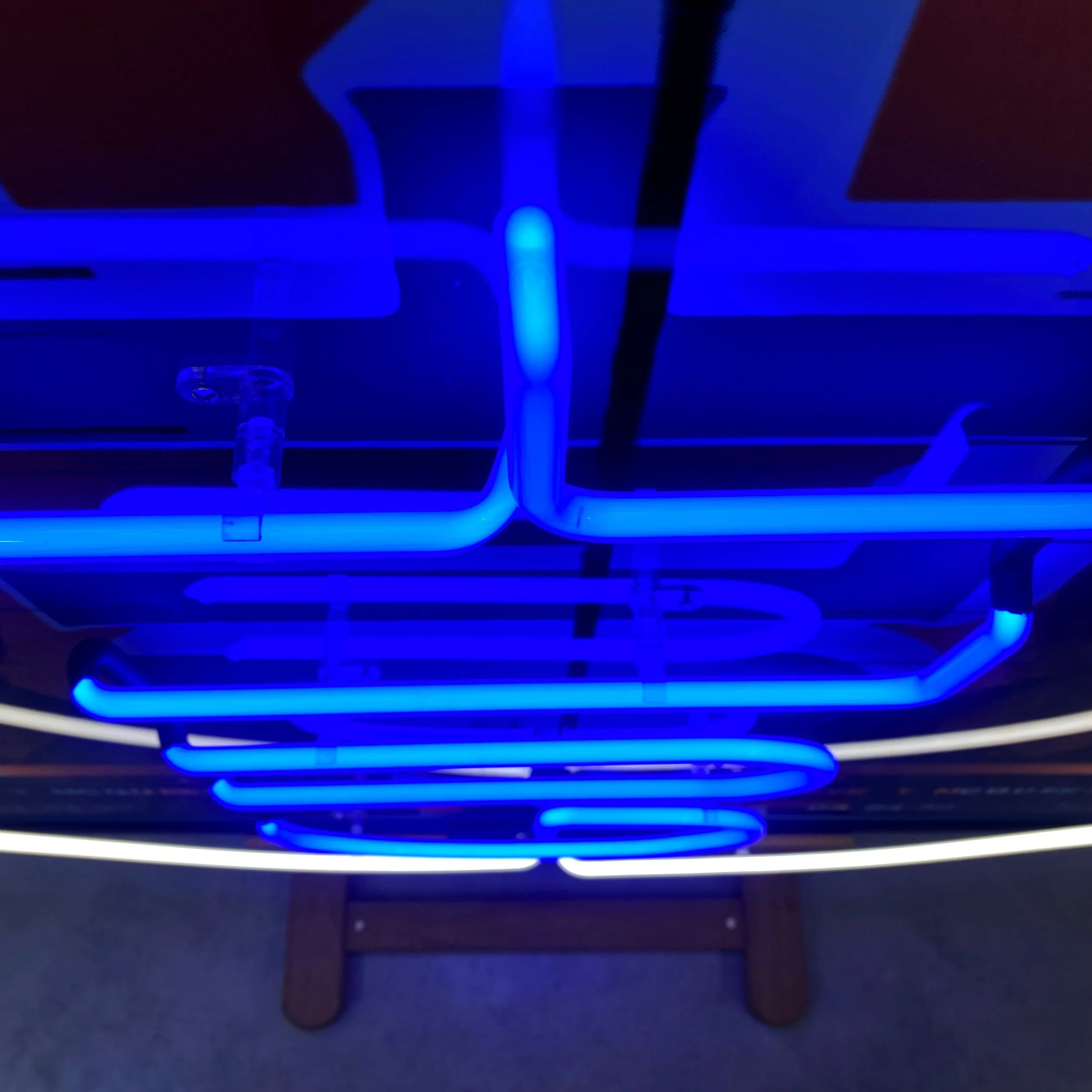
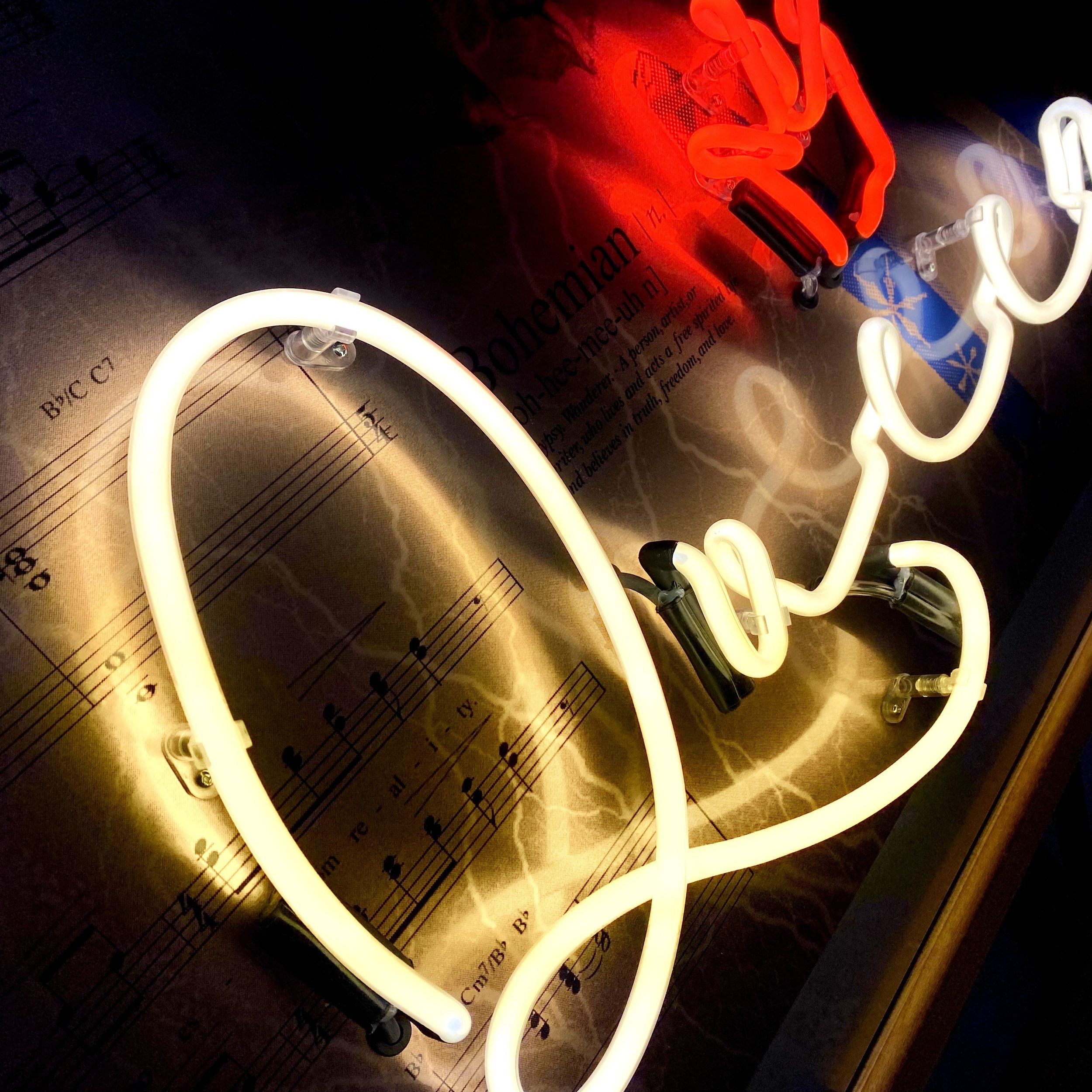
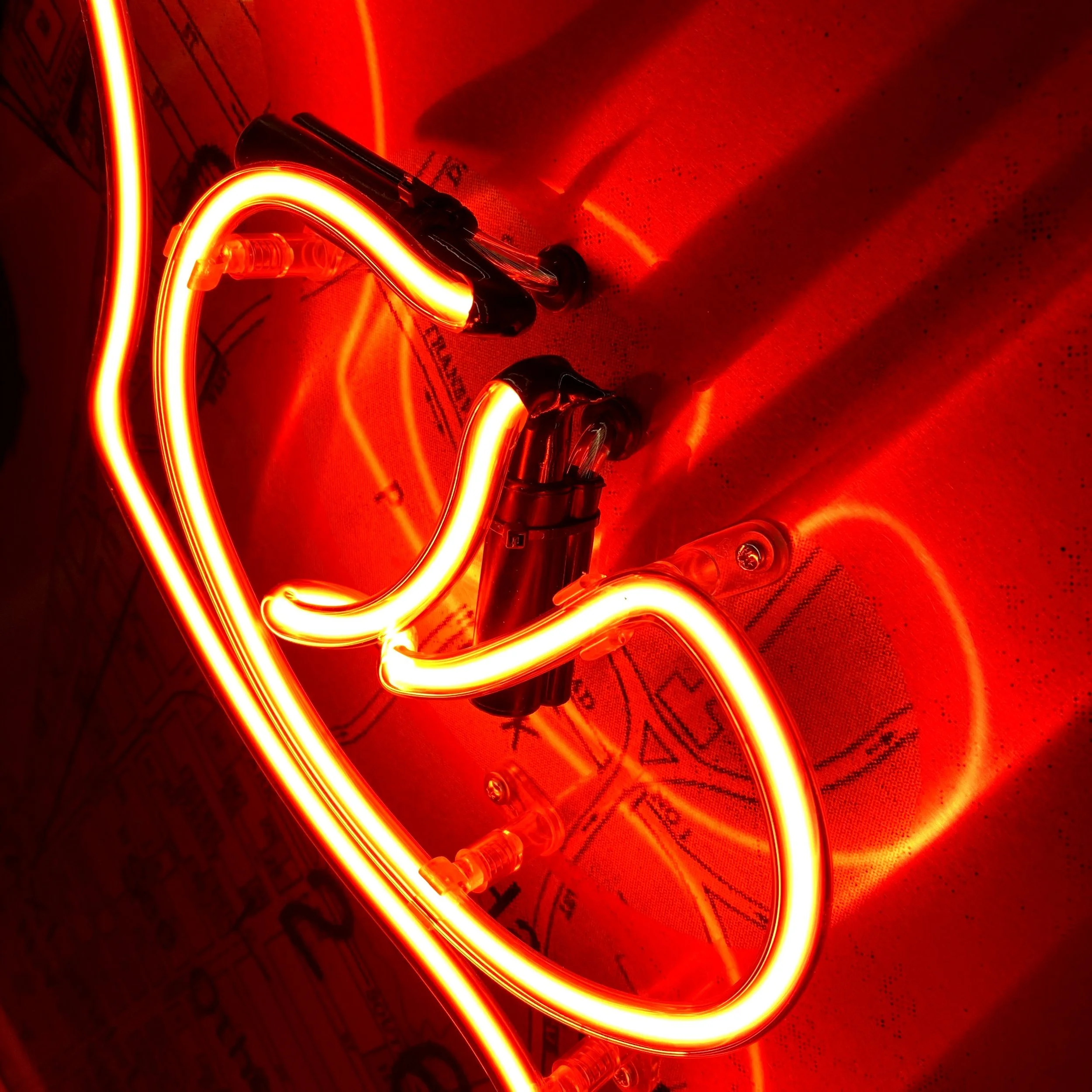
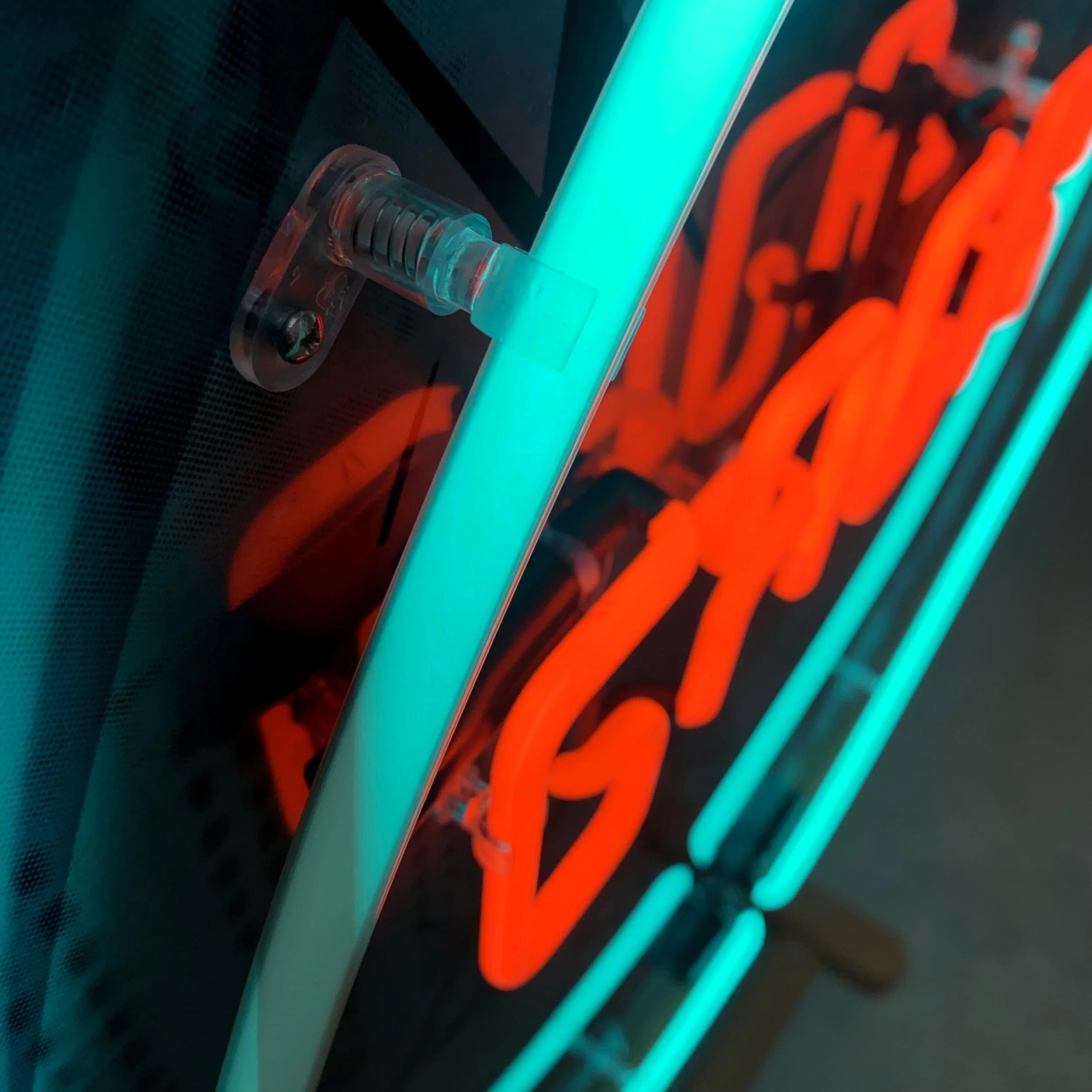
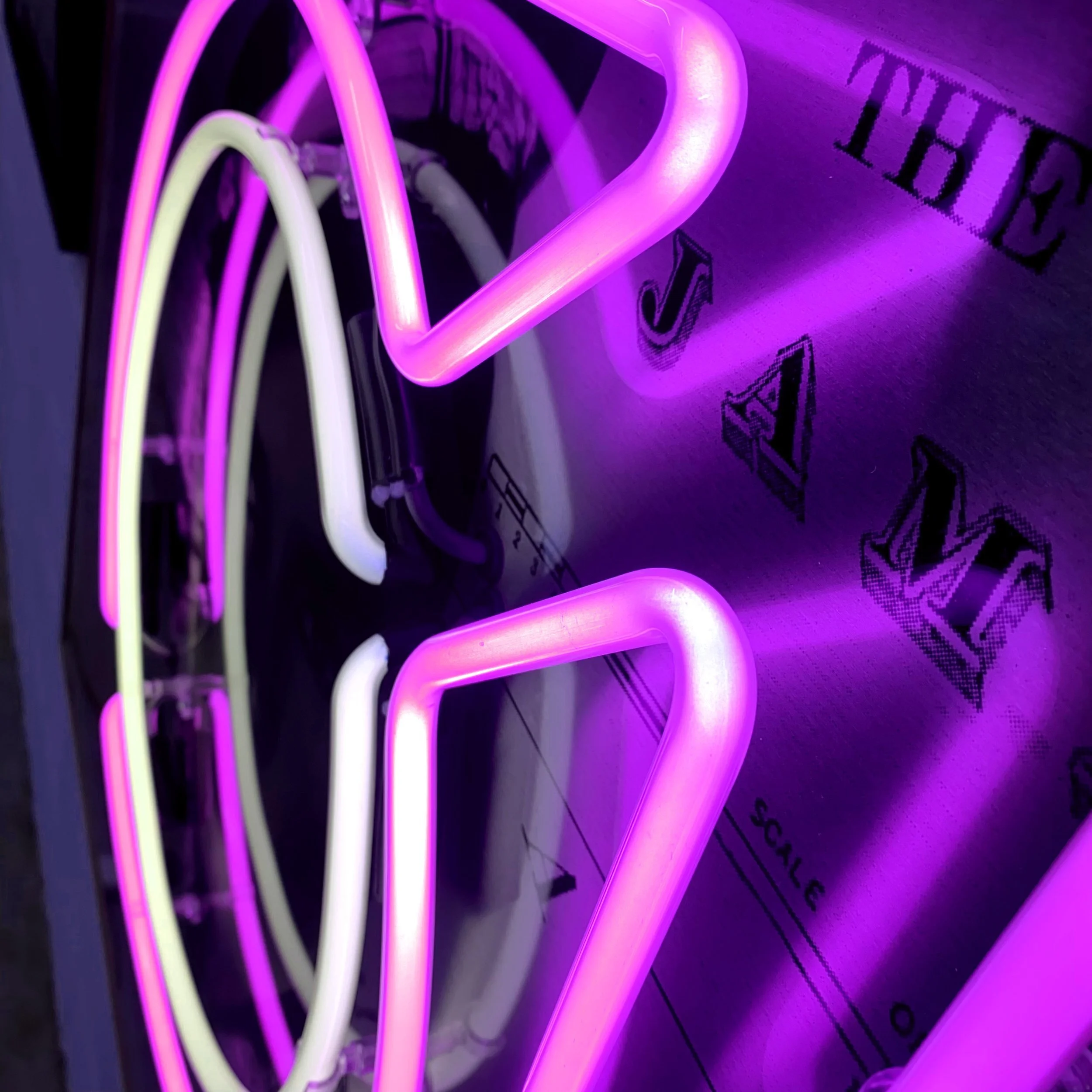
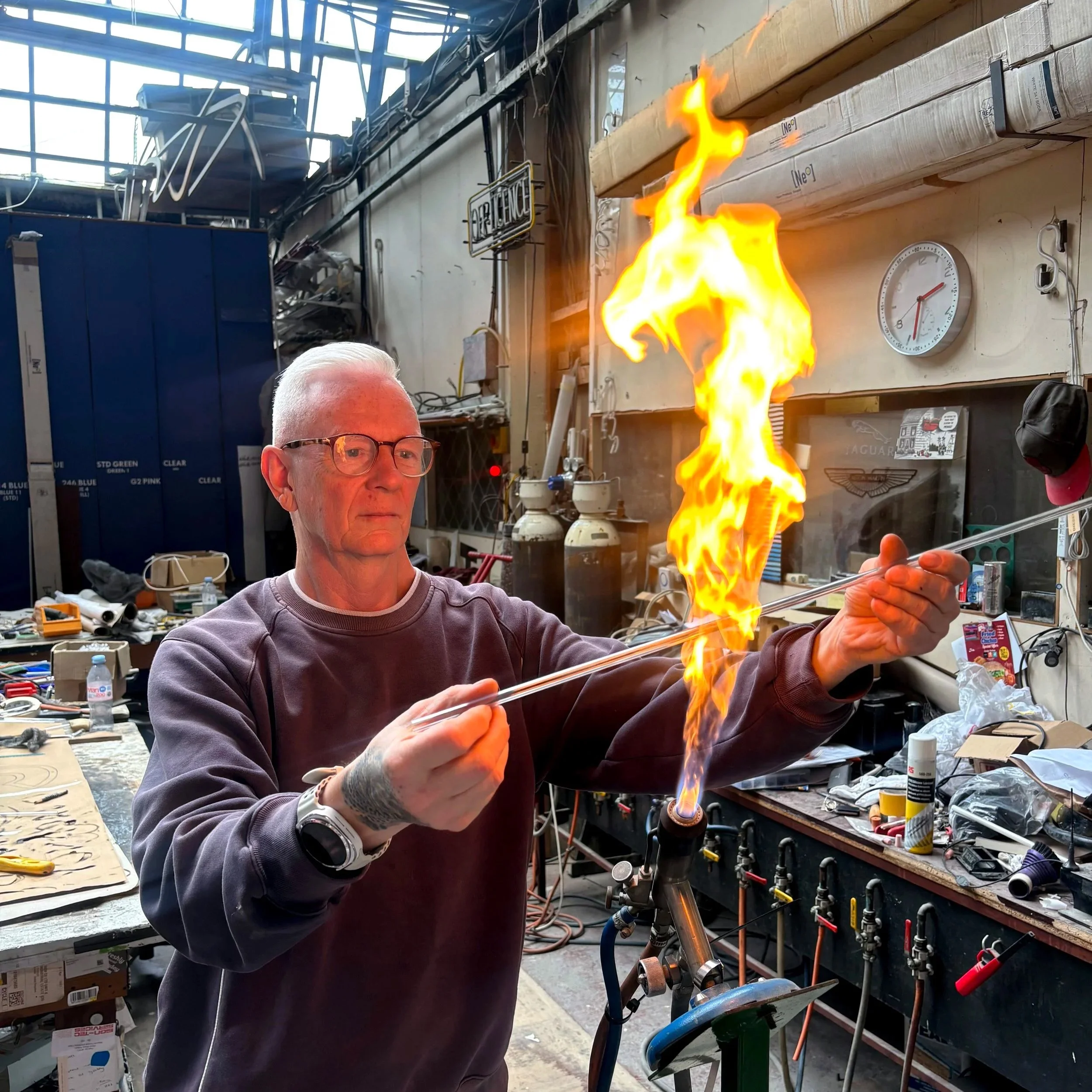
Master craftsman behind the neon.
Hand made neon glass craftsmanship at its finest.
Neon art available:
If you are interested in purchasing neon art, please contact us before placing order, so we can confirm framing options, timescales and delivery.
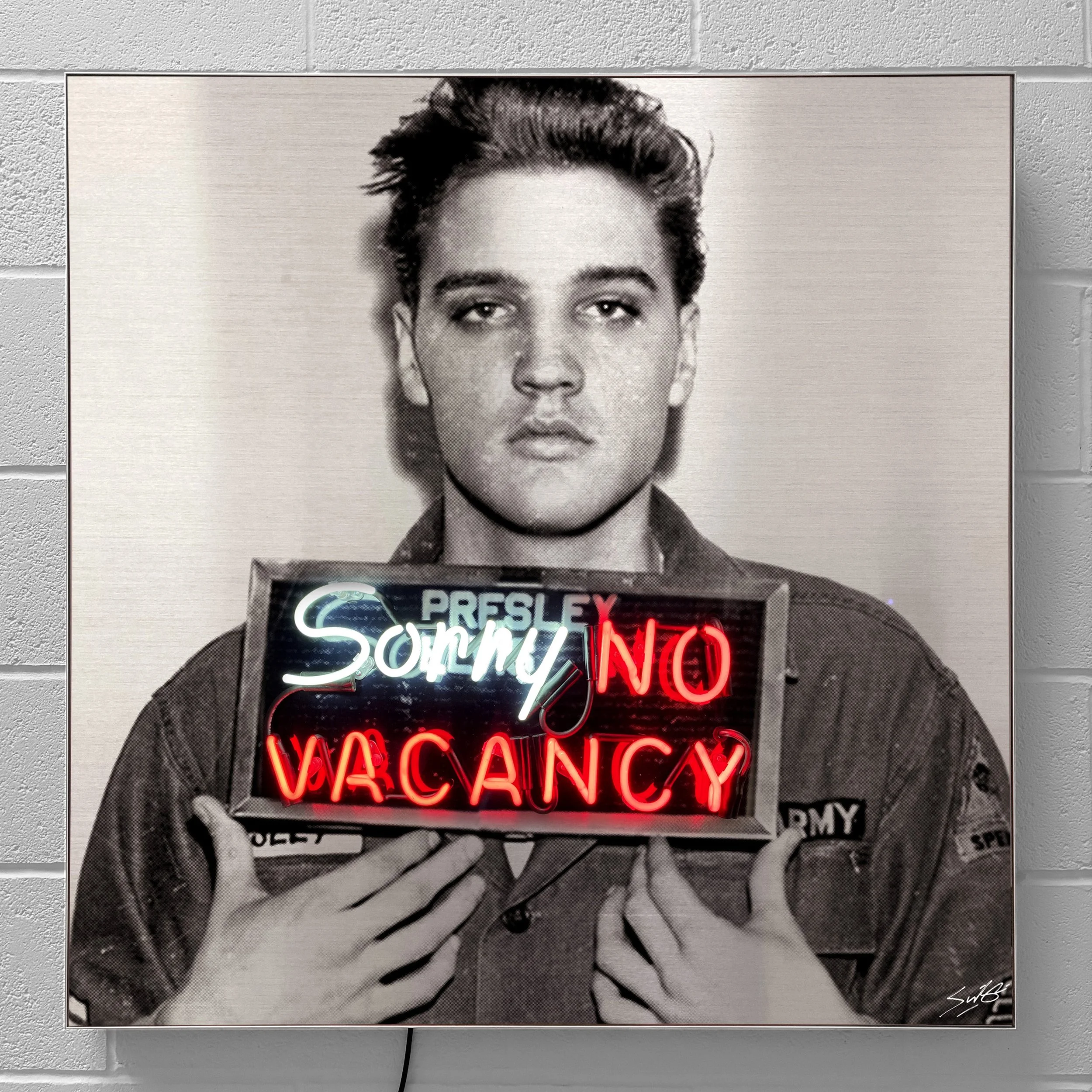
About:This neon artwork captures a pivotal moment in Elvis Presley’s life — his 1960 de-mob mugshot, taken just as he prepared to leave the army and step into a new chapter of fame. In this striking piece, the King confidently holds a glowing neon sign that playfully references his breakthrough hit “Heartbreak Hotel” — the song that launched him into rock ‘n’ roll legend in 1956.
Yet beneath the rebellious swagger lies a deeper spiritual undercurrent. The neon sign reading “Sorry, No Vacancy” becomes a modern parable: Even the biggest star in the world can find no room at the inn. Elvis stands at the threshold of leaving the army behind and stepping into superstardom. In the bright lights of fame, he’s both the ultimate star and a man who still feels the loneliness that often comes with it.
Made with signature aluminium and glowing neon, the piece turns a simple mugshot into something powerful and timeless. It quietly reminds us how quickly worldly success can come and go, and how even the biggest stars long for something deeper and more lasting.
Details: Traditional hand crafted clear glass vacuum tubes containing argon and neon gas. Mounted on mixed media brushed aluminium with a flawless high gloss finish.
Framed Size: 101cm x 101cm
Frame: Solid oak frame with aluminium finishing strip
Edition: Original
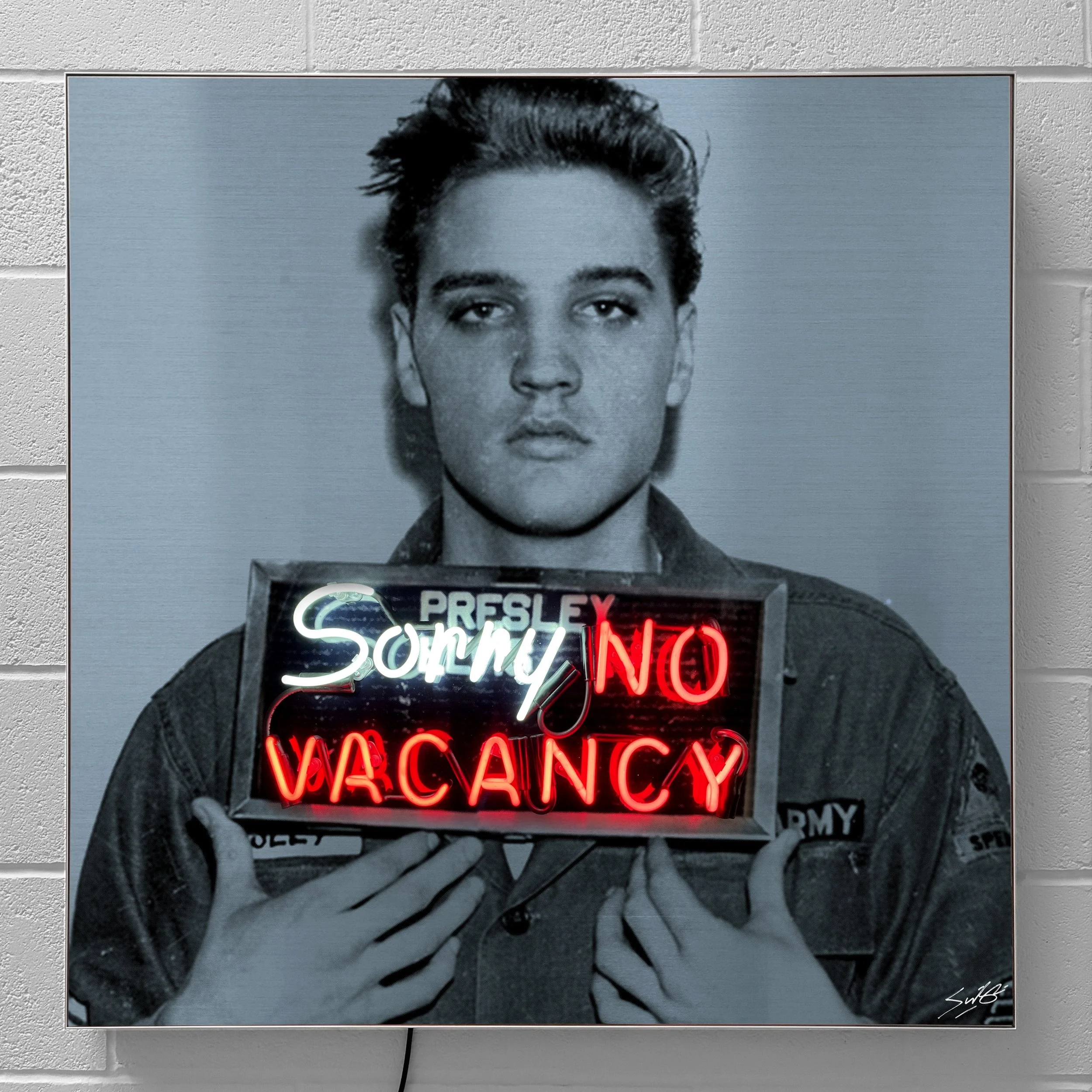
About:This neon artwork captures a pivotal moment in Elvis Presley’s life — his 1960 de-mob mugshot, taken just as he prepared to leave the army and step into a new chapter of fame. In this striking piece, the King confidently holds a glowing neon sign that playfully references his breakthrough hit “Heartbreak Hotel” — the song that launched him into rock ‘n’ roll legend in 1956.
Yet beneath the rebellious swagger lies a deeper spiritual undercurrent. The neon sign reading “Sorry, No Vacancy” becomes a modern parable: Even the biggest star in the world can find no room at the inn. Elvis stands at the threshold of leaving the army behind and stepping into superstardom. In the bright lights of fame, he’s both the ultimate star and a man who still feels the loneliness that often comes with it.
Made with signature aluminium and glowing neon, the piece turns a simple mugshot into something powerful and timeless. It quietly reminds us how quickly worldly success can come and go, and how even the biggest stars long for something deeper and more lasting.
Details: Traditional hand crafted clear glass vacuum tubes containing argon and neon gas. Mounted on mixed media brushed aluminium with a flawless high gloss finish.
Framed Size: 101cm x 101cm
Frame: Solid oak frame with aluminium finishing strip
Edition: Original
About:
This thought provoking art draws inspiration from the iconic Beatles record, "Revolution", which captured the essence of rebellion with its infectious guitar riffs and defiant lyrics. It became an anthem of the anti-establishment movement in the late 1960s, reminding us to question authority and embrace change.
But that's not all. It also finds its groove in the powerful counterculture track, "The Revolution Will Not Be Televised" by Gil Scott Heron. Through his biting social commentary, he emphasizes that change and revolution will not be conveniently broadcasted and consumed like an entertainment spectacle and that it requires active participation and cannot be passively observed on a television screen.
Enter the artwork itself – a portable black and white Sony TV from the late 1960s, recreated with skillful neon glass tubes outlining its form. The backdrop flaunts horizontal lines - a nostalgic sight on old-school black and white TVs of that era. On this TV screen, you'll witness The Beatles rocking out on the Ed Sullivan show in 1964. It was a historic moment, drawing a staggering 73 million people in front of their TV sets. The pop culture revolution had begun….
The artwork seamlessly combines all these influences into a captivating story. It embraces the power of the past and reminds us of the transformative potential within our modern world.
Below:
Listen To Gill Scott Heron “The Revolution Will Not Be Televised” and The Beatles “Revolution” which inspired this piece and also watch the moment The Beatles perform “Twist and Shout” on the Ed Sullivan show in 1964.
Details: Traditional hand crafted clear glass vacuum tubes containing argon and neon gas. Mounted on mixed media brushed aluminium with a flawless high gloss finish.
Framed Size: 101cm x 101cm
Edition: Original edition of 3 + 1AP

About:
"Faith" was released in October 1987 as the title track from George Michaels’s debut album of the same name. It held the number-one position on the Billboard Hot 100 chart for four weeks and was the number-one single of the year in the United States in 1988. The song also reached number two on the UK Singles Chart.
The artwork features a side profile of George Michael, his gaze fixated on a vibrant neon religious cross. The neon flawlessly weaves the title of the track, "FAITH," into its intricate glass design.
As you delve deeper into the artwork, you'll discover vintage print elements, paying homage to the track that took the world by storm. From the legendary BSA logo, prominently featured on George's leather jacket and a silhouette of the maestro himself gripping a guitar that echoes the imagery of the music video. The artwork also tastefully incorporates a cross-shaped fusion of a guitar and dance diagram steps, also influenced by early Andy Warhol works.
The backdrop of the piece is adorned with an intricate map of West London, an homage to Sarm West studios where the magic of "Faith" was first captured.
Below: Watch the official video for “Faith” which inspired this piece.
Details: Traditional hand crafted clear glass vacuum tubes containing argon and neon gas. Mounted on mixed media brushed aluminium with a flawless high gloss finish.
Framed Size: 101cm x 101cm
Edition: Original edition of 3

About: This neon edition is inspired by the Steve McQueen 1972 film "The Getaway", an action thriller film based on the 1958 novel by Jim Thompson and was one of the year's top ten films at the box office. The film directed by Sam Peckinpah, and also starred Ali MacGraw who McQueen had a public affair with during filming. She later married McQueen on July 13, 1973, in Cheyenne, Wyoming, and divorced him in 1978. The artwork features Steve McQueens actual passport, guns and bullets reflecting the theme of the film.
Details: Traditional hand crafted clear glass vacuum tubes containing argon and neon gas. Mounted on mixed media brushed aluminium with a flawless high gloss finish.
Framed Size: 101cm x 101cm
Edition: Original edition of 5
About:
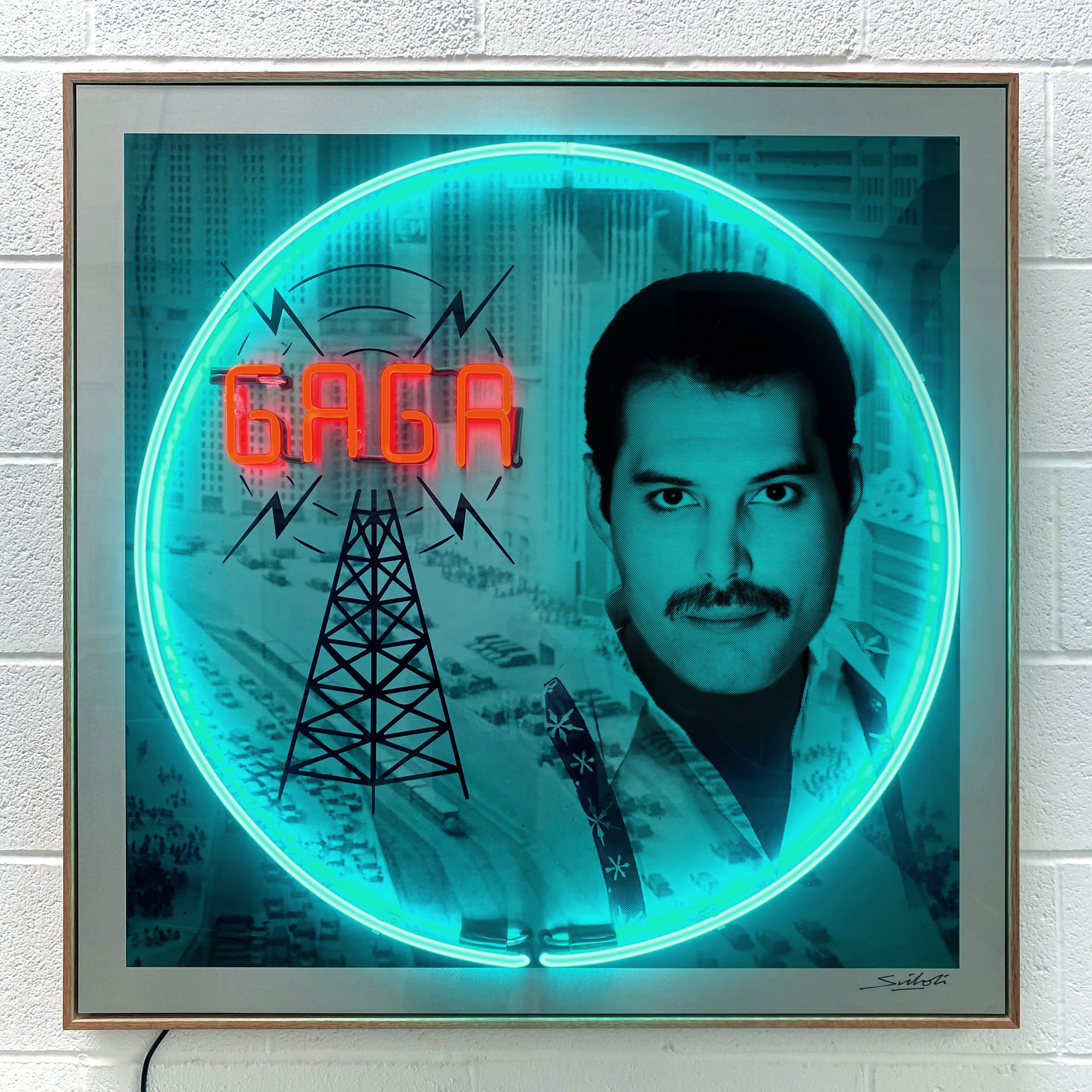
This artwork pays homage to the timeless 80’s anthem "Radio Gaga" by Queen, which captures the nostalgic power of radio and its ability to unite people through music. The artwork draws inspiration from the music video for "Radio Gaga" and features a backdrop of Fritz Lang's classic 1930’s film "Metropolis."
The futuristic art-deco cityscape, bustling with cars and people, sets the stage for Fred Mercury as the focal point, commanding attention with his charismatic presence. Encircled by a radiant deep turquoise neon tube, he symbolizes the electrifying energy of the iconic track.
However, it is the strikingly illuminated 20th century radio station mast that commands the central spot in this artwork. The word "Gaga," rendered in vibrant orange neon, is the crowning jewel of the piece.
Below: Watch the Queen “Radio Gaga” video from 1984 which inspired this piece.
Details: Traditional hand crafted clear glass vacuum tubes containing argon and neon gas. Mounted on mixed media brushed aluminium with a flawless high gloss finish.
Framed Size: 101cm x 101cm
Edition: Original edition of 3 + 1AP

About:
This neon print captures the electrifying energy of Freddie Mercury's iconic "Bohemian Rhapsody." The image of Freddie, surrounded by lightning, evokes the song's tempestuous atmosphere. Hidden details, like a Galileo sketch and a couple dancing the fandango, pay homage to the song's intricate composition. The centerpiece, the band's name in neon lights, celebrates Queen's legacy.
Below: Watch the Queen “Bohemian Rhapsody” video from 1976 which inspired this piece.
Details: Traditional hand crafted clear glass vacuum tubes containing argon and neon gas. Mounted on mixed media brushed aluminium with a flawless high gloss finish.
Framed Size: 101cm x 101cm
Edition: Original edition of 3 + 1AP

About:
This artwork chronicles the iconic story behind the single that catapulted Prince to superstardom and reached No7 in the UK in 1983. Later, it was re-released as a double A-side with "1999", peaking at number two on the UK Singles Chart in January 1985. The song depicts an encounter with an alluring sexually promiscuous woman, unfolding through a series of cheeky automotive sexual innuendos !
Prince is depicted in his flamboyant attire from the early 1980s, capturing the essence of his unrivaled charisma. Serving as a scenic backdrop, a vintage map of Minneapolis, Prince's cherished hometown and the location of his recording sanctuary, Paisley Park, exudes an air of reverence. An actual engineering drawing of an early 1980s Corvette seamlessly intertwines with the musical narrative, and is a subtle nod to the artists own automotive background.
At the heart of this artwork is a traditional neon sculpture, meticulously crafted with intricate clear glass and filled with neon and argon gas. Its luminous retro glow, lights up the surrounding space, transforming it into a mesmerising one-of-a-kind creation. The glass tubes remain completely transparent when the artwork is switched off.
Below: Watch the Prince official video for “Little Red Corvette” which inspired this piece.
Details: Traditional hand crafted clear glass vacuum tubes containing argon and neon gas. Mounted on mixed media brushed aluminium with a flawless high gloss finish.
Framed Size: 101cm x 101cm
Edition: Original edition of 3 + 1AP

About: Step into a world of extraterrestrial intrigue with this striking neon artwork, which is a homage to the iconic David Bowie. It captures the essence of his portrayal of the enigmatic alien Thomas Jerome Newton in the 1976 film “The Man Who Fell To Earth”, who has ventured from a faraway planet on a mission to save his parched homeland from an impending catastrophe – a devastating drought.
Embedded within the backdrop of the artwork is a celestial "star map" of the planets and stars, where you'll discover the 'chameleon' constellation, a profound metaphor for Bowie's unparalleled ability to metamorphose into endless images and personas throughout his illustrious career.
Details: Traditional hand crafted glass vacuum tubes containing argon and neon gas. Mounted on mixed media brushed aluminium with a flawless high gloss finish.
Neon art behind the scenes 2min video >
Framed Size: 101cm x 101cm
Edition: Series of 5 originals.

About: This is inspired by one of the most iconic films of all time - Martin Scorceses “Taxi Driver” from 1976. The print incorporates Robert De Niro’s actual taxi driver licence he obtained whilst training as a taxi driver in preparation for the film. It also features a 1970’s vintage map of midtown Manhattan with a New York skyline where it was filmed on location. The neon lights are formed in the shape of a classic Checker Cab as featured in the film that is morphed into the shape of a handgun.
Details: Traditional hand crafted clear glass vacuum tubes containing argon and neon gas. Mounted on mixed media brushed aluminium with a flawless high gloss finish.
Framed Size: 101cm x 101cm
Edition: Original edition of 5
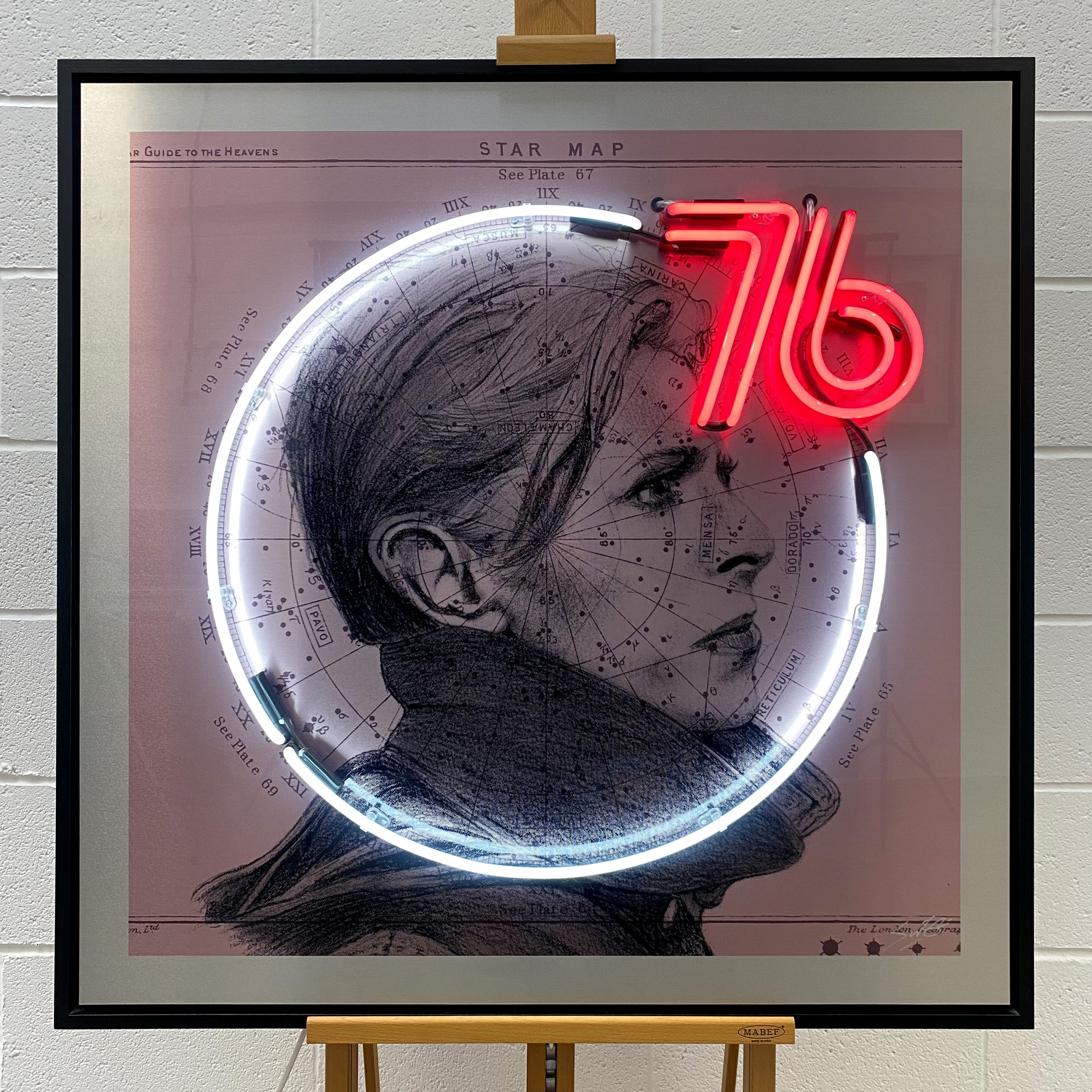
About: Step into a world of extraterrestrial intrigue with this striking neon artwork, which is a homage to the iconic David Bowie. It captures the essence of his portrayal of the enigmatic alien Thomas Jerome Newton in the 1976 film “The Man Who Fell To Earth”, who has ventured from a faraway planet on a mission to save his parched homeland from an impending catastrophe – a devastating drought.
Embedded within the backdrop of the artwork is a celestial "star map" of the planets and stars, where you'll discover the 'chameleon' constellation, a profound metaphor for Bowie's unparalleled ability to metamorphose into endless images and personas throughout his illustrious career.
Details: Traditional hand crafted clear glass vacuum tubes containing argon and neon gas. Mounted on mixed media brushed aluminium with a flawless high gloss finish.
Framed Size: 101cm x 101cm
Edition: Original edition of 1

About: This unique edition in aqua and white neon was Inspired by the 1979 Blondie classic "Sunday Girl" - the fourth single from their third studio album “Parallel Lines”, which was released in May 1979 in the UK and reached number one on the charts for 3 weeks. The hand pencil sketch which is the basis of the artwork is inspired by the single cover and the glass neon wording “Ice Cream” references the lyrics from the track “I know a girl from a lonely street, cold as ice cream but still as sweet'”.
Details: Traditional hand crafted clear glass vacuum tubes containing argon and neon gas. Mounted on mixed media brushed aluminium with a flawless high gloss finish.
Framed Size: 101cm x 101cm
Edition: Original edition of 5

About: This limited edition was inspired by the track “Rock N Roll Suicide” from the Ziggy Stardust album of 1972. It references “Gitane” French cigarettes that Bowie was famous for smoking in the 70’s and 80’s. It depicts smoke drifting out of a pair of lips in the French tricolour. The main image is based on the original mugshot of David Bowie who was arrested on March 21, 1976, after a performance in Rochester, New York. About half a pound of a “certain substance that you smoke” was confiscated by the police. Bowie was held with three others including Iggy Pop, for several hours and then released on $2,000 bond. Bowie later pleaded not guilty and a grand jury decided to pass on the case.
Details: Traditional hand crafted glass vacuum tubes containing argon and neon gas. Mounted on mixed media brushed aluminium with a flawless high gloss finish.
Framed Size: 84cm x 124cm
Edition: Original edition of 10

About: This Debbie Harry portrait was inspired by her patronage of the infamous Studio 54 nightclub in the 1979-1981 period. Harry along with Andy Warhol was a regular fixture at the club which has gone down in pop culture as the greatest nightclub of all time. The neon tubes evoke the vibe of the 1970’s club scene when neon was in its commercial heyday.
Details: Traditional hand crafted clear glass vacuum tubes containing argon and neon gas. Mounted on mixed media brushed aluminium with a flawless high gloss finish.
Framed Size: 101cm x 101cm
Edition: Original edition of 5

About:
In March 1983, David Bowie's "Let's Dance"became his most mainstream achievement by soaring to the top of charts worldwide. The song's music video, filmed in Australia, shed light on the struggles faced by Aboriginal Australians.
The artwork masterfully captures the compelling story of this iconic record and the message it conveyed. At its heart, a striking pair of glass neon red shoes command attention, not only embodying the song's lyrics but also encapsulating the video's poignant theme. The shoes symbolize the collision between consumer capitalism and the hardships experienced by the Aboriginal community. They also reference the film "Red Shoes," renowned for its cultural significance.
Set against a backdrop of Australia's map, the artwork pays homage to the video's location in Carinda, a tiny town nestled in New South Wales. This visual representation adds depth and contextual relevance to the piece, immersing viewers in the location where the narrative unfolded.
Furthermore, art enthusiasts will find clever nods to Andy Warhol woven into the composition. The red shoes, meticulously screen-printed on aluminium, harken back to Warhol's iconic "Halston" shoe series from the early 1980s. Additionally, an allusion to Warhol's early 1960s works is found through the inclusion of a dance manual teaching how to “Dance The Blues”.
Below: Watch the official video for “Let’s Dance” which inspired this piece.
Details: Traditional hand crafted clear glass vacuum tubes containing argon and neon gas. Mounted on mixed media brushed aluminium with a flawless high gloss finish.
Framed Size: 101cm x 101cm
Edition: Original edition of 3 + 1AP

About: With Debbie Harry as its centerpiece, oozing ice-cool attitude in her classic sunglasses, this piece captures the very essence of punk and the raw edginess that defined Blondie's raw unedited early music.
Inspired by a hidden gem in Blondie's 1977 "Plastic Letters" album, this piece exudes rebellious punk rock attitude. Taking its name from the Oldsmobile 442, the infamous American muscle car, it tells the tale of a young rebel forced into the monotonous world of car assembly amid bleak imagery of concrete factories and assembly lines.
The collage style artwork featuring a vintage Detroit map and eye-catching Oldsmobile 442 marketing materials from the period forms the backdrop, while a re-imagined Blondie logo formed out of a single piece of glass glows in rebellious red neon at the artwork's base.
Below: Watch the official Blondie video for “Detroit 442” which inspired this piece.
Details: Traditional hand crafted clear glass vacuum tubes containing argon and neon gas. Mounted on mixed media brushed aluminium with a flawless high gloss finish.
Framed Size: 101cm x 101cm
Edition: Original edition of 3 + 1AP

About:
A nautical-inspired neon masterpiece paying tribute to the iconic songstress Grace Jones. Drawing inspiration from her 1975 debut hit "I Need A Man" and her legendary 1980’s greatest hits compilation "Island Life," this artwork seamlessly intertwines both musical milestones and encapsulates Grace Jones' cultural impact, pushing the boundaries of art, music and gender.
Immerse yourself in the disco era with Grace dressed as a sailor, reminiscent of her late 70's period. This imagery finds its roots in a very famous image of Marlene Dietrich donning a sailor uniform. Renowned artist Richard Bernstein, a dear friend of Grace Jones and the chief designer behind Andy Warhol’s "Interview Magazine," also immortalized her in this striking sailor outfit for the back cover of her 1978 "Fame" album.
The backdrop incorporates a print collage, carefully crafted from vintage materials. Delve into her roots with a map of Jamaica, the birthplace that shaped her into the legendary performer we know today. Adding a touch of unexpected is a torn image from a 1950's gay porn magazine featuring a sailor, referencing her status as a gay icon and enhancing the artwork's playful intrigue. Stealing the spotlight at the foot of the portrait is the title of her debut disco track "I Need A Man," stenciled with engineering precision.
A delectably intelligent twist unfolds as the artwork plays with Grace Jones' gender-bending persona. The iconic neon lights depicting the "male sex symbol" are reinvented in pink feminine hues, unleashing a delightful paradox, as Grace herself embodies the essence of masculinity !
Below: Watch Grace Jones performing live in 1981:
Details: Traditional hand crafted clear glass vacuum tubes containing argon and neon gas. Mounted on mixed media brushed aluminium with a flawless high gloss finish.
Framed Size: 101cm x 101cm
Edition: Original edition of 3 + 1AP

About: George Michael rose to fame as a member of the music duo Wham! and later embarked on a successful solo career. He sold over 80 million records worldwide making him one of the best-selling music artists of all time. This piece was inspired by his infamous LA public toilet incident and the music video for the 1998 single “Outside” which featured him dancing around a urinal in a nightclub. The dark colour scheme and red neon evoke the ambiance of a nightclub setting.
Details: Traditional hand crafted clear glass vacuum tubes containing argon and neon gas. Mounted on mixed media brushed aluminium with a flawless high gloss finish.
Framed Size: 101cm x 101cm
Edition: Original edition of 5

About: Steve McQueen: A Tale of Rebellion and Racing
This portrait pays homage to the iconic Hollywood star, Steve McQueen, utilizing his notable mugshot from an incident that occurred in Anchorage, Alaska in 1972. McQueen, renowned for his stellar performances in movies like "The Magnificent Seven" and "The Great Escape," found himself entangled in legal trouble when he was apprehended for driving under the influence (DUI).
After being taken into custody, McQueen swiftly posted bail, leaving the quaint town behind. However, his evasion did not prevent him from facing the repercussions of his actions. In absentia, the talented actor was ultimately convicted for his reckless driving.
To emphasize McQueen's adventurous and rebellious spirit, this portrait boldly superimposes a larger-than-life "Gulf racing" sign. This striking feature pays tribute to his notable participation in the exhilarating 1971 film "Le Mans," where he fearlessly raced a Gulf Porsche 917. Inspired by this adrenaline-fueled performance, the vibrant neon sign represents McQueen's passion for speed, risk-taking, and his affinity for the world of racing.
Details: Traditional hand crafted clear glass vacuum tubes containing argon and neon gas. Mounted on mixed media brushed aluminium with a flawless high gloss finish.
Framed Size: 101cm x 101cm
Edition: Original edition of 5
About:
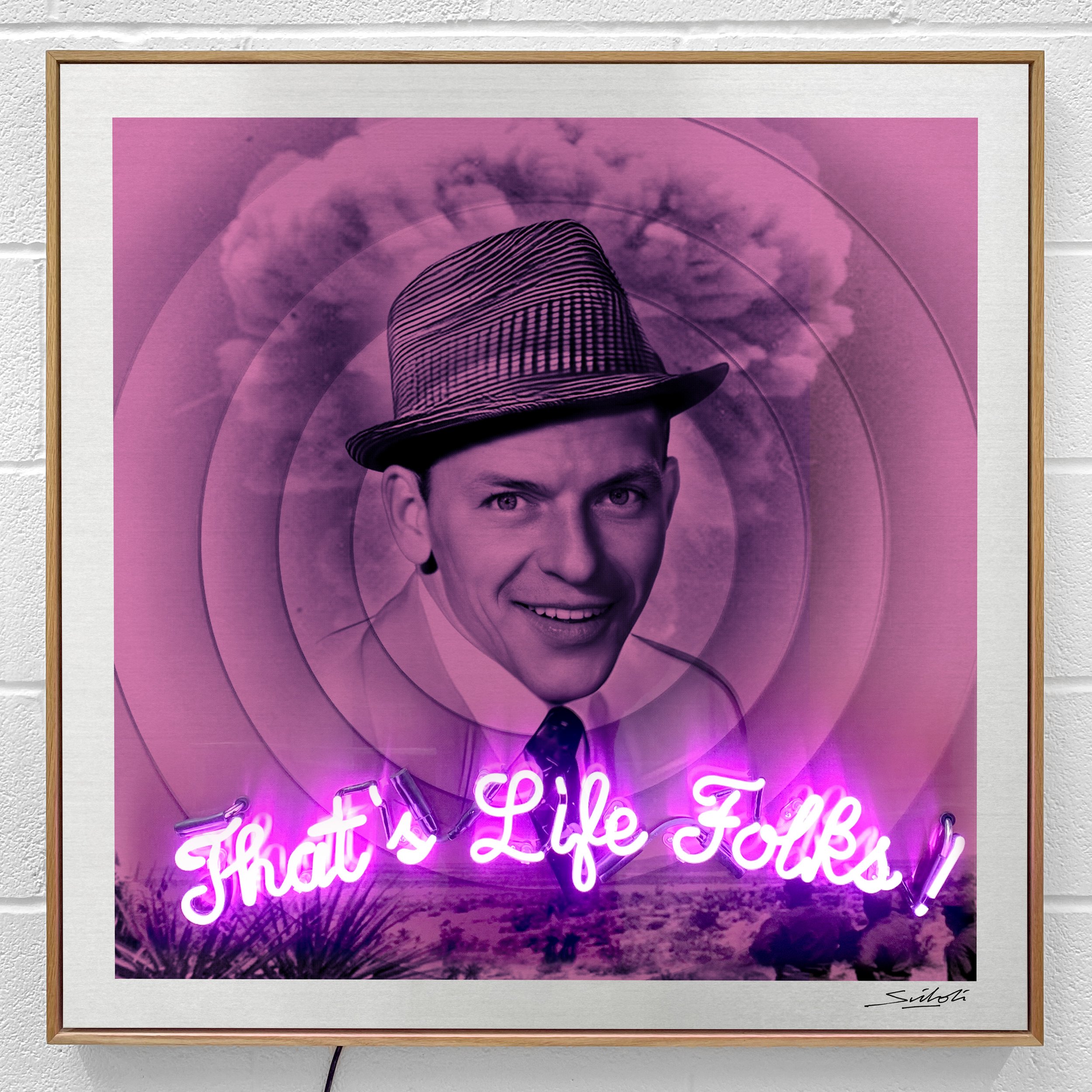
Sinatra swagger from Blue Eyes himself himself dodging a nuclear bomb under neon lights. Inspired by Sinatra's iconic "That's Life" and its recent resurgence in the 2019 Joker movie, this artwork carries personal meaning for the artist, weaving multiple layers of clever messages and symbolism.
At the center, we see Sinatra superimposed on the classic Warner Brothers Looney Tunes "That's All Folks" ending sequence. A stark contrast unfolds against this familiar cartoon backdrop: a nuclear bomb explodes in the background, juxtaposed with a vibrant magenta neon sign pulsating with Sinatra's signature lyric, "That's Life Folks."
This imagery represents the harsh realities of life. When faced with setbacks and challenges, akin to the metaphorical "nuclear bomb," going off, the artwork suggests resilience and perseverance.
Life throws "nuclear bombs," the artist says, “But like Frank says in the song, you gotta dust yourself off and get back in the race.”
Below: Watch Frank Sinatra perform “That’s Life” and scenes from The Joker which inspired this piece:
Details: Traditional hand crafted clear glass vacuum tubes containing argon and neon gas. Mounted on mixed media brushed aluminium with a flawless high gloss finish.
Framed Size: 101cm x 101cm
Edition: Original edition of 3 + 1AP

About: The Godfather is widely regarded as one of the greatest films of all time and is ranked the second greatest film in American cinema by the American Film Institute (Behind Citizen Kane). The 1972 epic crime drama featured Marlon Brando as “Don Vito Corleone”, the head of a powerful Italian-American crime family, based on Mario Puzo's best-selling 1969 novel of the same name. The artwork was inspired by the quote in the film “ In Sicily, women are more dangerous than shotguns!” It features an actual map of Sicily showing the village of Corleone - the fictional birth place of Don Corleone (Above his RHS eye). The stylised graphic image of Marlon Brando’s face is rendered to appear like the contours of a map. The Warhol inspired shotgun screen prints are overlaid with real glass neon tubes, formed in the shape of a gun in the Italian flag colours: red, white and green.
Details: Traditional hand crafted clear glass vacuum tubes containing argon and neon gas. Mounted on mixed media brushed aluminium with a flawless high gloss finish.
Framed Size: 101cm x 101cm
Edition: Original edition of 5

About: This neon edition is based on Steve McQueen in the 1971 film "Le Mans" in which he raced a Gulf Porsche 917. The background collage features the official race line up for Le Mans 1970, from which actual footage was used in the film.
Details: Traditional hand crafted clear glass vacuum tubes containing argon and neon gas. Mounted on mixed media brushed aluminium with a flawless high gloss finish.
Framed Size: 101cm x 101cm
Edition: Original edition of 5
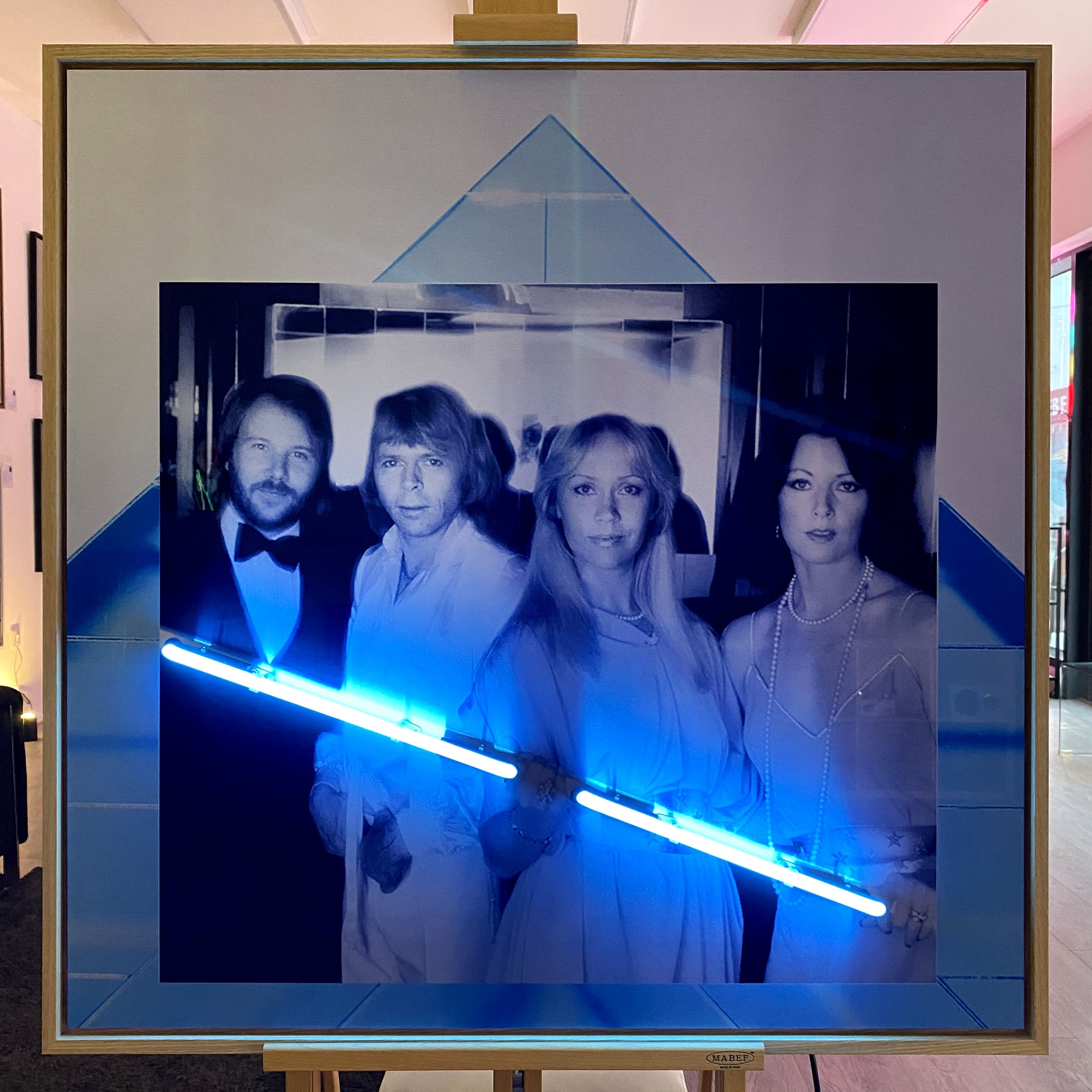
About: Voulez Vous; (French for "Do you want?") is the sixth studio album by the Swedish supergroup ABBA, released on 23 April 1979. which featured a single of the same name. Abba had moved on from their early 1970’s glam rock period and started to embrace disco music, which was at its peak at the time. The album topped the charts in a number of countries and was one of the top five-selling albums in the UK for that year. This neon artwork is a re-imagined 3D version of the album cover using a similar photo which was taken at Alexandra's night club in Stockholm, which hinted at the disco theme. The reflective surface of the brushed aluminium artwork and the real glass neon lights replicate the original photo which features the group standing in a reflective mirrored room with Agnetha and Frida holding a neon tube. The neon lights provide the perfect medium for this image with its 1970’s disco vibe.
Medium: Print, graphics, neon art
Materials: Brushed aluminium with high gloss finish and hand blown traditional glass neon tubes.
Aluminium Size: 95 x 95cm
Framed size: 99.4 x 99.4cm
Edition: 5 signed and numbered by artist.
Frame: Float mounted in oak.
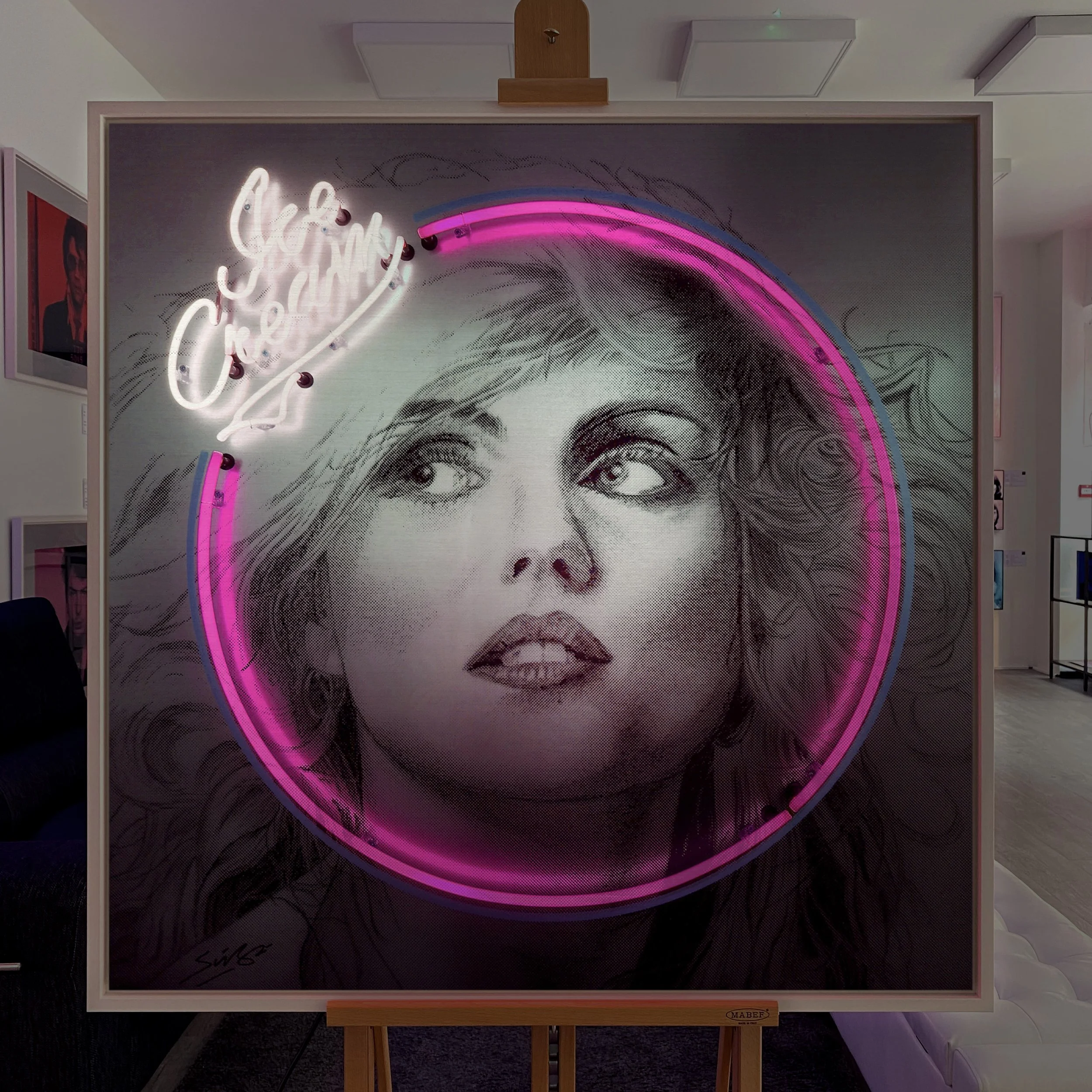
About: This unique edition in magenta and white neon was Inspired by the 1979 Blondie classic "Sunday Girl" - the fourth single from their third studio album “Parallel Lines”, which was released in May 1979 in the UK and reached number one on the charts for 3 weeks. The hand pencil sketch which is the basis of the artwork is inspired by the single cover and the glass neon wording “Ice Cream” references the lyrics from the track “I know a girl from a lonely street, cold as ice cream but still as sweet'”.
Details: Traditional hand crafted clear glass vacuum tubes containing argon and neon gas. Mounted on mixed media brushed aluminium with a flawless high gloss finish.
Framed Size: 101cm x 101cm
Edition: Original edition of 1
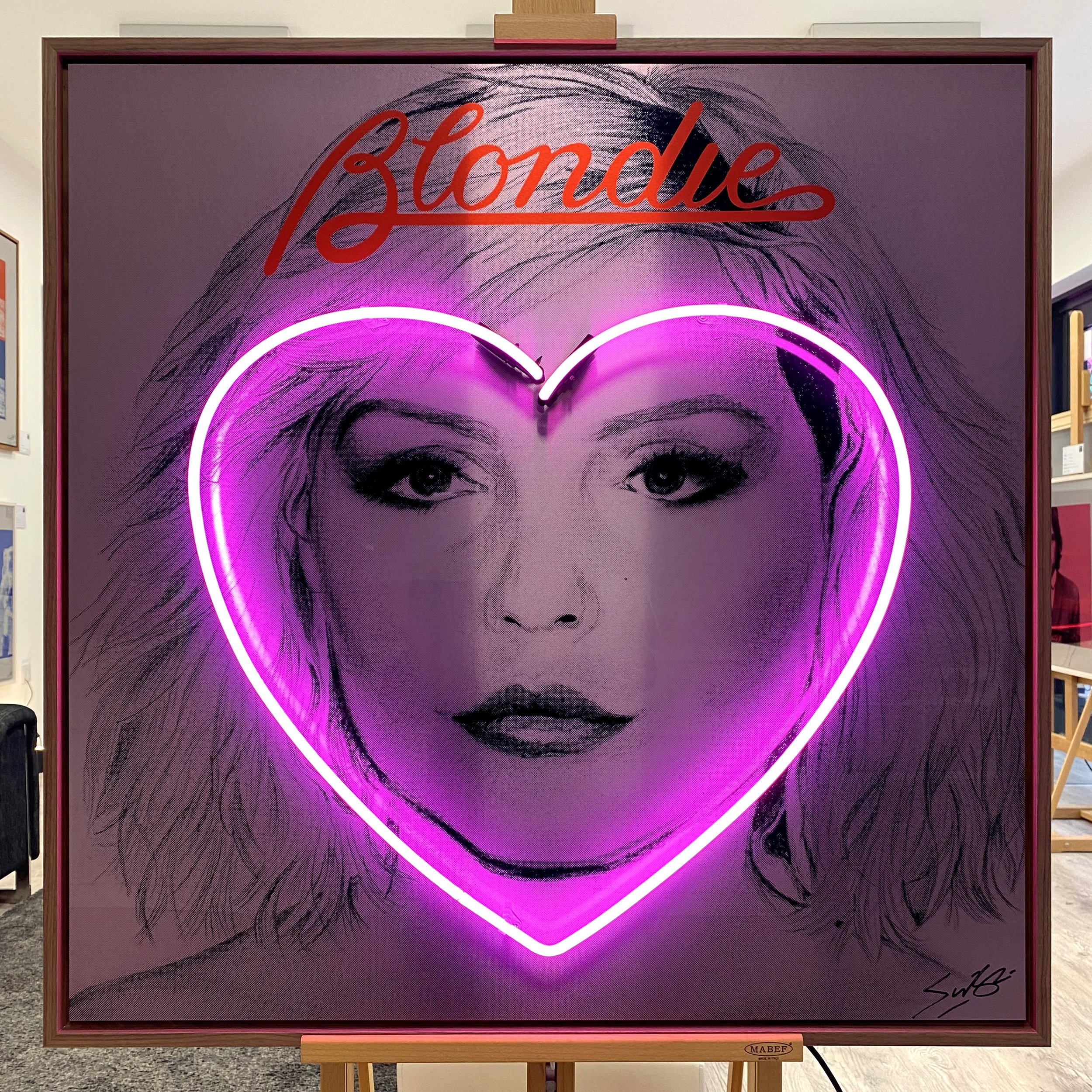
About: This edition was Inspired by the 1979 Blondie disco classic "Heart of Glass" - the fourth single from their third studio album “Parallel Lines”, which was released in January 1979 and reached number one on the charts in several countries, including the United States and the United Kingdom. "Heart of Glass" ranked at number 66 in the UK's official list of biggest selling singles of all-time with sales of 1.32 million copies. It was inducted into the Grammy Hall of Fame as a recording of "qualitative or historical significance" in 2015. The portrait features a pencil sketch of Debbie Harry circa 1979 printed on brushed aluminium with a very literal heart of glass !
Details: Traditional hand crafted coloured glass neon tubes which are vacuum filled with argon gas and mounted on high grade brushed aluminium artwork with a flawless high gloss finish. The wood and aluminium artwork construction features ‘plug and play’ design for simple installation.
Neon art behind the scenes 2min video >
Framed Size: 99cm x 99cm
Edition: Unique 1/1 signed and numbered by artist.
Frame: Bespoke walnut.

About: This portrait of the Queen was created using a vintage 1977 pictorial souvenir, by Olwen Hedley, celebrating The Queens Silver Jubilee. This also happens to be the original source material Andy Warhol used for his “Reigning Queens" portfolio of 1985 and also the iconic image Jamie Reid's used for the cover for the Sex Pistols “God Save the Queen”. The image of the queen is juxtapositioned twith the chemical element symbol for Platinum taken from the "periodic table of elements". Platinum is a precious metal and one of the most rare elements in the earths crust. Hence why it represents the Queens 70 years on the throne - a first for a British monarch.
Details: Traditional hand crafted clear glass vacuum tubes containing argon and neon gas. Mounted on mixed media brushed aluminium with a flawless high gloss finish.
Framed Size: 101cm x 101cm
Edition: Original edition of 1
Neon Art User Manual: View>
All images © Louis Sidoli
https://x.com/LouisSidoli https://www.instagram.com/louissidoli/ https://www.linkedin.com/in/louis-sidoli/ https://www.youtube.com/@LouisSidoli https://www.saatchiart.com/louissidoli
About:This neon artwork captures a pivotal moment in Elvis Presley’s life — his 1960 de-mob mugshot, taken just as he prepared to leave the army and step into a new chapter of fame. In this striking piece, the King confidently holds a glowing neon sign that playfully references his breakthrough hit “Heartbreak Hotel” — the song that launched him into rock ‘n’ roll legend in 1956.
Yet beneath the rebellious swagger lies a deeper spiritual undercurrent. The neon sign reading “Sorry, No Vacancy” becomes a modern parable: Even the biggest star in the world can find no room at the inn. Elvis stands at the threshold of leaving the army behind and stepping into superstardom. In the bright lights of fame, he’s both the ultimate star and a man who still feels the loneliness that often comes with it.
Made with signature aluminium and glowing neon, the piece turns a simple mugshot into something powerful and timeless. It quietly reminds us how quickly worldly success can come and go, and how even the biggest stars long for something deeper and more lasting.
Details: Traditional hand crafted clear glass vacuum tubes containing argon and neon gas. Mounted on mixed media brushed aluminium with a flawless high gloss finish.
Framed Size: 101cm x 101cm
Edition: Original